

FDA In Motion: New Fees, Fresh Data, Open Funding, Submission Strategies & More
On The Reg 04

On the Reg is our newest channel, devoted to spotlighting strategy, opinion, and insights from neurotech’s evolving regulatory landscape. It’s written for and by commercial leaders and experts from our audience of engaged readers. And it’s open to contributors like you!
Last month we recapped Vermont’s neural data protections, looked into Neurovalens regulatory progress, FDA guidance on adjunctive pain measurement devices, leadership commentary, CDRH’s use of real-world evidence, human factors guidance, reciprocal staff-sharing initiative, and more.
This month we’re diving into the following:
Wave Neuro’s 510k for PTSD Therapy with Individualized TMS
FDA Proposes new User Fees for Med Device Firms under MDUFA
FDA Approval Timelines Are Longer in 2026
Update on FDA’s Total Product Lifecycle Advisory Program (TAP)
Debate: Can FDA Pivotal Trial Meet CMS’s coverage needs?
FDA Funding Opportunity: Digital Health Technologies for Drug Development
FDA-Cleared LLM for Patients: Not Quite. Not Yet. Not Ever?
Thanks to Mittal Consulting for their original analysis, as well as Silverman Strategies, MDDI, MedTech Strategist, and STAT News for the coverage informing this issue’s contents.
To contribute featured analysis or commentary of neurotech company news or regulatory developments, send me a note with your proposed idea and brief background. Scroll to the end for more guidance here.
Wave Neuro Introduces Individualized TMS Therapy for PTSD Using an Unconventional 510(k) Approach
By: Susan Lubejko PhD and Abigail Copeland PhD, Regulatory Affairs Specialists at Mittal Consulting
For both drugs and devices, personalized therapies that target specific patient biomarkers and tailor treatments to individual biological needs are the next big thing. Historically, the FDA has opted for device clearances with narrow permutations that don’t differ much between patients. Given the promise of these paradigms and the potential mismatch with the typical regulator stance, case studies that demonstrate success, especially those that use unconventional submission strategies, are important for device manufacturers looking to innovate in this space.
Wave Neuroscience’s recent 510(k) clearance for the MeRT System (K260402) provides an intriguing view into potential regulatory pathways for introducing individualized therapy into well-established neurotech fields. The Magnetic EEG/ECG Resonance Therapy (MeRT) System’s proprietary machine-learning driven algorithm (MRT-005) uses patients’ EEG/ECG recordings measuring brain activity at rest to predict the ideal, personalized transcranial magnetic stimulation (TMS) treatment parameters to program into compatible TMS hardware to deliver therapy to patients with post-traumatic stress disorder (PTSD).
MeRT is the first to bring both treatment for PTSD and use of individualized therapy to the established TMS space. Existing FDA-cleared TMS treatments are only “individualized” based on a field-standard procedure to determine each patient’s intensity threshold, not neural signatures. Stimulation location, frequency, pulse pattern, and intensity in relation to that threshold are typically locked in premarket submissions. Wave Neuro received clearance for a range of some of these parameters, allowing for personalization for each patient.
While the novelty of Wave Neuro’s innovation lies in its proprietary algorithm component MRT-005, the company successfully secured their 510(k) using an established MagVenture TMS hardware system indicated for obsessive compulsive disorder (OCD) as the predicate. Because 510(k) submissions require demonstration of equivalence in intended use and technology to an FDA-cleared device, using a hardware predicate for a software algorithm is usually unsuccessful. How was Wave Neuro able to introduce therapy individualization to the established TMS field using this unconventional argument?
Wave Neuro used three important strategies that all likely contributed to this success.
First, building upon an established partnership with MagVenture, Wave Neuro posed their device as a two-component system: their MRT-005 algorithm and another manufacturer’s compatible hardware system. Wave Neuro’s 510(k) submission focuses heavily on TMS technology itself, with less discussion of the treatment-defining algorithm.
Second, MRT-005 can only recommend treatment parameters that already fit within the existing operating specifications of the MagVenture hardware (e.g. MRT-005 may recommend stimulation frequency between 8 and 13 Hz, which is well within the 0.1 - 30 Hz range that the hardware can already accommodate). These first two points plausibly allowed FDA to conclude that there are no new patient risks associated with keeping the system within its existing limits.
Third, Wave Neuro conducted a clinical study to support the shift from OCD to PTSD and demonstrate that personalization of the TMS parameters is at least as effective as standard, non-personalized TMS therapy. This follows a common thread in the TMS space to use clinical data to validate treatment of new disease states and further allowed Wave Neuro to emphasize that the personalized stimulation is just as safe as the established methods FDA is used to reviewing.
While the particulars of this predicate argument are nontraditional from a regulatory perspective, the MeRT clearance demonstrates that a move toward individualized neurological therapy is underway and becoming accepted by US regulators. For submissions, FDA’s neurology branch appears to be open to introduction of novel software algorithms for this purpose based on the demonstration that the outputs work within the specifications of cleared hardware. Manufacturers of software innovations may consider similar partnership with hardware manufacturers, or at least the argument of matching specifications, in discussions with FDA review teams to further decrease the regulatory burden of new software-driven innovations.
For further analysis of Wave’s clearance, see last month’s issue of Signals
MDUFA VI (FY 2028-2032) Newly Proposed FDA Pre-Submission Fee
By: Susan Lubejko PhD and Abigail Copeland PhD, Regulatory Affairs Specialists at Mittal Consulting
On July 7, 2026, FDA published a draft commitment letter detailing proposed recommendations for the reauthorization of the Medical Device User Fee Amendments (MDUFA), which govern how medical device manufacturers interact with FDA and fund medical device review in the United States, for fiscal years 2028 through 2032 (MDUFA VI). While the recommendations are pending public commentary and Congressional approval, meaning they are subject to potential change before being finalized, MDUFA drafts provide a look into FDA’s current thinking on the fees and timelines associated with interactive programs and marketing submissions. Notably, sponsors will find the proposed changes to the Pre-Submission program of particular interest: the MDUFA VI draft introduces Deposit fees for initial Traditional Pre-Submissions and a new Focused Follow-Up Pre-Submission for feedback on targeted questions cutting the FDA feedback time almost in half.
Before jumping into the specifics, let’s take a brief look at the history of MDUFA. In the early 2000s, as medical device companies became frustrated with unpredictable FDA review timelines for their marketing applications, they worked with FDA to implement MDUFA, the medical device analog of a submission fee program already proven successful for FDA drug review, for more FDA commitment on predictable timelines.
MDUFA has been positively viewed by both industry and FDA and continuously re-renewed, bringing us to the current MDUFA VI renewal cycle.
Of particular interest in the MDUFA VI amendments are proposed changes to the Pre-Submission program. Pre-Submission usage has grown substantially in recent years. Last fiscal year alone, FDA reviewed a whopping 4502 Pre-Submissions, up 26% over the previous 5-year average and including both original pre-submissions and pre- submission supplements. To put this in perspective, in FY2025 FDA reviewed 4,151 510(k)s, the most typical marketing application, indicating that FDA reviewers can expect to encounter and spend time on just as many free-to-submit Pre-Submissions as user fee-driven marketing applications. However, Pre-Submissions are invaluable for Sponsors, especially those early in development of novel, complex technologies, as the process allows them to get on the same page early with the FDA in terms of device design, testing, and regulatory strategy, de-risking the oftentimes arduous pathway ahead.
Now let’s look at the two proposed changes to the Pre-Submission program. First is a proposed deposit of $2,000 for a device’s first original Pre-Submission that will be then credited to Sponsors upon the submission of a later marketing application. The rationale for this fee is to compensate FDA for the time-intensive review of such submissions and may reduce review load by encouraging Sponsors to pursue Pre-Submissions only when seriously considering a marketing application. Pre-Submission supplements are not subject to this fee, and the FDA review timeline for original and supplement submissions remains unchanged at 70 calendar days. While a $2000 fee may not seem like much now, MDUFA fees go up every renewal cycle, and over time, rising Pre-Submission fees may stifle early innovation from small companies. Importantly, it is not yet clear how the Pre-Submission deposit would be implemented for device types that do not have marketing application fees associated with them, such as pediatric and humanitarian use devices. Additionally, it is unclear if Pre-Submission deposit fees for Sponsors designated as small businesses will also be reduced, as these companies are currently offered discounted marketing submission fees. It will be essential for MDUFA to clarify how the fee will be handled in these key areas.
Second, MDUFA VI proposed a new Focused Follow-Up Pre-Submission, which would allow Sponsors to pose a single topic with a small number of focused questions to FDA, with a 45-day written feedback window instead of 70 days. The Focused Follow-Up Pre- Submission is great news for Sponsors who need quick clarification on one or two points, without the hold-up of the 70-day review timeline for feedback.
While the reduced review timeline of the proposed Focused Follow-Up Pre-Submission is undisputably positive, the proposed Pre-Submission deposit may raise concerns for small medical device manufacturers weighing the timing of their first FDA interaction. For Sponsors who are interested in providing public feedback on outlined recommendations, a public meeting discussing MDUFA VI will be held on August 5, 2026, and electronic comments will be accepted through August 6, 2026. Following the comment period and revisions, MDUFA VI will head to Capitol Hill for Congressional review with the finalized recommendations taking effect October 1, 2027.
FDA Approval Timelines Are Longer in 2026
MDDI summarized a recent report from BDIG found that FDA’s approvals are up compared to last year, but that they are taking longer.
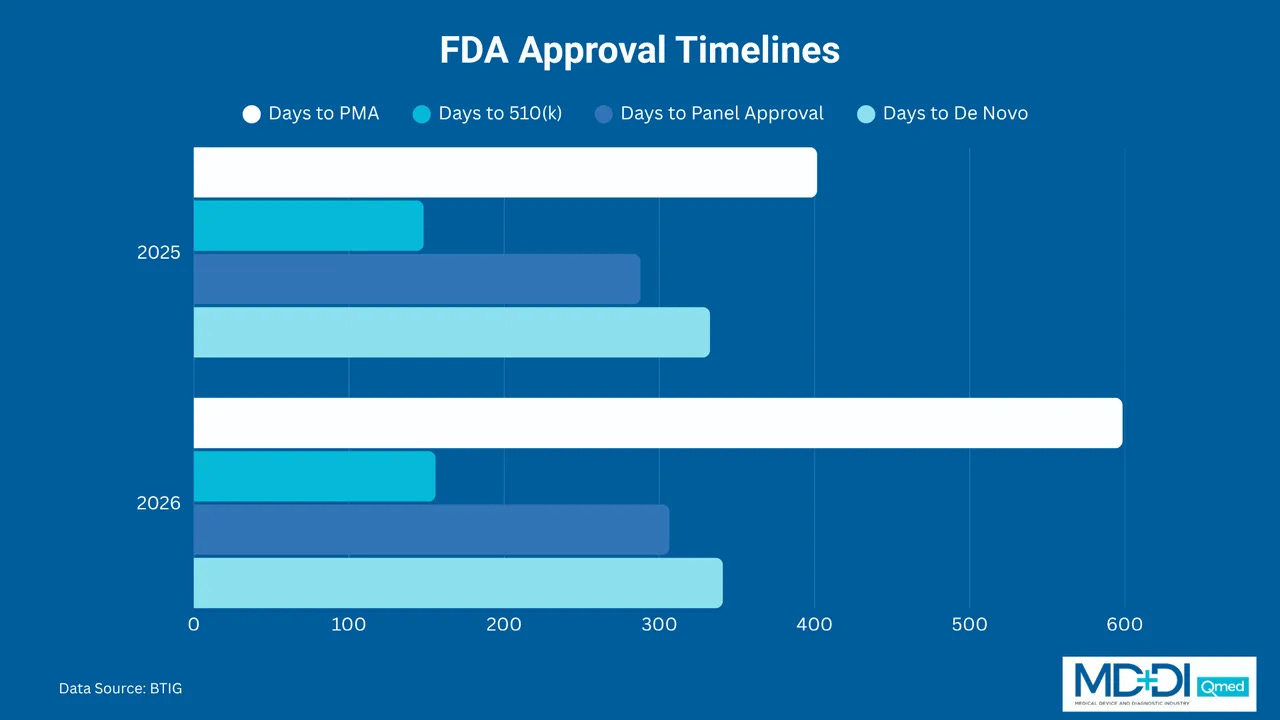
Pre-market approvals (PMA): 23 original PMAs through June 2026, up 10 from this time last year. PMA are taking 599 days this year, compared to about 402 days in 2025.
FDA 510(k) clearances are trending up about 2.5% year-over-year as 1,669 medical devices have been cleared through June 2026, with 156 average days to a 510(k) submission decision this year.
De novo: There have been 14 de novo classifications through June 2026, consistent with last year.
“Overall, we’re encouraged by the absolute level of approvals within medical technology tracks,” wrote the report’s analyst, “but we believe for many reading this, the timing to approval carries more importance in terms of the implications of capital runway and demand forecasting (especially for smaller companies bringing new technologies to market).”
For more detailed analysis of what these numbers mean for medical device firms planning submission strategy, see Steve Silverman’s recent piece in What the FDA.

FDA TAP Update: 133 devices to date, 38 new companies in the last year
This month the FDA announced that 133 devices have been enrolled in its TAP pilot as of July 1. The agency also wrote the program has “expanded to accept enrollment requests across all Offices of Health Technologies (OHTs) for Breakthrough-designated and Safer Technologies Program (STeP) devices that meet TAP enrollment criteria described below.”
In December, the FDA published an assessment of the pilot, based on data through August 2025: There were 95 companies enrolled in the TAP pilot as of then, meaning the agency added an additional 38 companies in the last year. This means that the program is current 92 companies short of the “Up to 225 Devices” goal for FY26, which ends in two months.
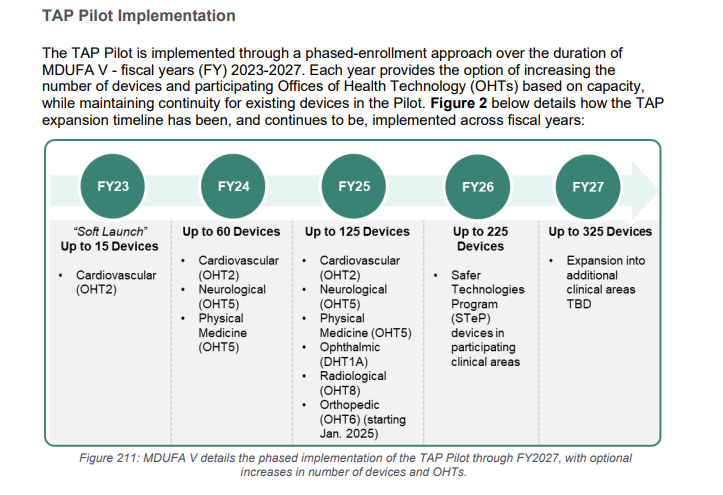
Page 26 of the FDA’s draft commitment letter contains more detail on the agency’s plans to formalize this pilot into a “a sustainable, full TAP program covering all product areas, with voluntary enrollment targeted to eligible devices across all OHTs no later than October 1, 2027.”
Lastly, while the new announcement does mention the newly proposed RAPID pathway, the draft commitment letter does not mention this program by name in the TAP section or anywhere else in the report.
Debate: Can FDA Pivotal Trial Meet CMS’s coverage needs?
This is a summary of MedTech Strategist’s May 14th article recapping an on-stage debate between Josh Makower, MD, co-founder and director of the Stanford Mussallem Center for Biodesign, and Steve Farmer, MD, former chief strategy officer for coverage at CMS and architect of the TCET program.
Steve Farmer: I think it’s unlikely that you’re going to conduct a single pivotal trial that actually satisfies a reasonable and necessary standard, at least for high-risk devices, because of the way that pivotal trials are designed. They’re typically designed to identify the ideal patient who is likely to show the benefits of a technology, which very, very frequently is not representative of the patients who are the intended users of the technology.
Makower: I think both parties, CMS and FDA, need to follow some sort of reasonableness standard…A nominal amount to achieve statistical significance would be reasonable…One of the greatest things that could come of this is for a trial to be outlined up front, which would, if successful, establish the framework for “reasonable and necessary…” I think in TCET, you really were not able to engage even to be considered for TCET until you were approaching your approval. You weren’t really doing this at the IDE stage … which means you've already placed your bet on a trial design, right?”
Check out the whole back and forth here.
If you need a refresher of the proposed RAPID program:
“Under RAPID, CMS will join discussions with FDA and sponsors to identify what clinical outcomes matter for Medicare patients in medical device clinical studies, so sponsors are equipped with the knowledge of what evidence will satisfy both FDA and CMS requirements.
Eligibility includes Class II Breakthrough-designated devices which are also enrolled in the FDA’s Total Product Life Cycle Advisory Program (TAP), as well as Class III Breakthrough Designated Devices regardless of TAP enrollment. All devices must be the subject of an Investigational Device Exemption (IDE) clinical study that enrolls Medicare beneficiaries such that both FDA and CMS can weigh in on the outcomes to be addressed in the study. More here.”
Funding Opportunity: Use of Digital Health Technologies in Drug Development
This funding announcement was posted July 20th with a deadline of August 20th. More context available here, including an Aug 27 webinar. From the RFA:
The overarching goal of this notice of funding opportunity (NOFO) is to explore the role of DHTs (e.g., actigraphy, photography, contactless sensors) in drug development.
A DHT is a system that uses computing platforms, connectivity, software, and/or sensors, for health care and related uses. DHTs for remote data acquisition in clinical investigations can include hardware and/or software to perform one or more functions. DHTs may rely on or work with other technologies that support their operation, such as general-purpose computing platforms (e.g., smartphones) and communication networks.
These projects may involve engagement with researchers from academia, the biopharmaceutical industry, patient groups, and other stakeholders. The objectives of these projects are to advance DHTs for clinical drug development, expand the ability to capture early manifestations of chronic diseases, determine outcomes in populations with unmet medical needs and enhance convenience for trial participants by allowing for remote data acquisition in clinical investigations. The scope includes, but is not limited to, projects that focus on:
Comparing digital measurements to traditional measurements in clinical trials to evaluate drugs
Developing and evaluating novel endpoints using DHTs to address unmet needs for drug clinical trials (e.g., use of contactless room sensors to capture apnea in pediatric patients)
Comparing metrics to evaluate continuous measurements (e.g., maximum activity and stamina)
Capturing early manifestations of chronic diseases (e.g., non-memory related signs of dementia) through the use of DHTs (e.g., tests of balance or slowed reaction time)
Award will provide 1 (one) year of support and include future recommended support for up to 1 (one) additional year contingent upon annual appropriations, availability of funding and satisfactory recipient performance. CDER intends to commit up to $2.2 million in FY 2026 to fund up to 2 (two) awards.
An FDA-Cleared LLM for Patients: Not Quite. Not Yet. Not Ever?
STAT reported on UpDoc’s FDA clearance for an insulin dose calculator built on a Software as a Medical Device (SaMD) application using a chat interface.
But the company’s claims of being “the first FDA-cleared agentic clinical AI platform” didn’t stand up to the scrutiny of several independent regulatory experts, who suggest the agentic features are just a UI wrapper, rather than a true clinical intelligence layer that makes decisions.
“Product developers and medical device experts have been closely watching to see how FDA will regulate LLMs that are used in clinical care. Because the technology’s outputs are unpredictable, there’s concern that LLM-based clinical guidance might mislead users, their clinicians, or otherwise lead to harm. There are many questions about what the FDA will require to make sure an LLM-based medical device is safe.”
The obvious tell is that UpDoc’s clearance is based on a predicate device from 2018, whereas a high-risk use of LLM would likely require a de novo pathway. Companies incorporating generative AI layers into applications like radiology imaging interpretation are in the FDA’s Breakthrough pathway.
Healthcare is rushing to adopt AI in clinical workflows, despite uncertainty of demonstrable benefits over general purpose tools. For patient-facing applications, the question is even more of a no-brainer: Is any regulated clinical strategy for agentic AI even worth pursuing in areas of patient engagement, symptom monitoring, disease management, and so on?
That’s a wrap on this issue! I’m looking for additional regulatory experts to contribute to next month’s issue. Hit reply and let me know:
What regulatory headlines are most important for founders, commercial leaders and investors to understand, and why?
Tell me about specific company approvals or clearances, or related trends analysis of markets, modalities, sectors you want to see covered.
Ditto for program level analysis and interpretation across FDA, CMS, other agencies.
Can you help out by contributing global regulatory developments across Europe, Asia, and other markets?
The FDA/CMS trial-design mismatch feels bigger than a coordination problem to me. FDA trials are usually built to produce a clean answer, while coverage decisions have to ask whether the device helps older, messier patients in ordinary care. Bringing CMS in earlier only really helps if those patients and outcomes make it into the pivotal study, not as evidence collected after launch.