

Models to Markets: BCI, Neural Data, and Business Innovation in the AI Era
Representations 01: A new limited series from PL Neuro & Neurotech Futures

Representations is a new limited series exploring neurotech’s evolving business frontier. This is produced in partnership with PL Neuro, a project by Protocol Labs. PL Neuro accelerates neurotechnology and neuro AI through field building, strategic investment, and scientific research. Their worldview is deeply technical at every level, yet wholly focused on enabling futures of human flourishing and empowerment. Over the coming months we’ll explore key topics, trends, and themes, featuring experts from PL Neuro’s ecosystem and market insights curated from Neurotech Futures’ platform.
Business Model Innovation In the AI Era
If BCI companies are also data companies, and data companies are AI companies, are BCI companies becoming AI companies?
This evolving trajectory suggests unprecedented opportunities for social and economic impact far beyond the traditional bounds of the medtech industry.
At the core of this transformation is a powerful bidirectional synergy: neural foundation models - large AI systems trained on human brain activity - unlock new BCI capabilities, while proprietary BCI data drives the performance of those models. While this intersection is classified as “NeuroAI,” the real story is the wave of business model innovation being unleashed before our eyes.
“The term NeuroAI has no single definition,” wrote Anthony Zador from Cold Spring Harbor, “but it has largely come to refer to two related and partly intertwined research programs…neuroscience inspiring advances in AI, and AI providing a testing ground for models in neuroscience,” describing a positive feedback loop accelerating progress in both fields.. The NIH summarizes NeuroAI as “a framework where neuroscience and AI drive reciprocal advances with mutual benefits.”
These benefits range from publications and large scale datasets to new methods and applications, private IP, revenue and more. Where, when, how, and to whom will such benefits accrue? On the flipside: What is brain data worth? Who is willing to pay? What does it cost to access?
Your mileage may vary across a global landscape of independent research labs, non-profits, academic institutions, public-private partnerships, established companies, and startups, including but not limited to today’s leading BCI companies.
To me, NeuroAI offers a keyhole view into business model innovations that will drive neurotech’s scalability beyond medical device markets. It’s already begun. Dileep George calls it “closing the loop between AI and neuroscience.” A precambrian explosion of new models, brain mapping platforms, and neurobiology-inspired applications is afoot. It’s only 2026 and current active markets already encompass product R&D, data licensing, and other applications.
The exponential growth of high resolution neural data and ever-shrinking application development lifecycles are creating a glidepath for BCI to move from niche medical devices towards deeptech platforms and beyond. NeuroAI companies are emerging, built on an ML-tapestry of datasets to answer the question: What are we using this data for?
Introducing PL Neuro
ICYMI: Neural Data On the Move
Today, a BCI startup’s intentions for the creation of novel data-generating interfaces, development of proprietary models and other IP using this data, and negotiation of commercial contracts on the basis of those assets…is just business, right?
Sort of. Traditionally, data strategy in BCI mostly stayed between FDA-painted lines, prioritizing well-established processes across product development, animal studies, and the gauntlet of regulatory submissions through clinical and pre-commercial evidence generation stages.
But 2025 was a tipping point, with key signals emerging that BCI companies are neural data companies. In this new paradigm, BCI companies act as the ultimate gatekeepers for neural data, translating exclusive access into immense strategic and commercial value.
Synchron + NVIDIA = Chiral: A year ago Synchron announced a foundation model to enable self-learning, personalization, and more. This month’s Wired story highlights the acceleration at play for Synchron’s clinical trial participant Rodney Gorham. Mr. Gorham went from a single click BCI user five years ago to “using two iPads side by side, switching between playing a game on one and listening to music on the other.” Is the Stentrode an endovascular implant, or the key to a bespoke NeuroAI system for tunes, chill, dim, nom, vroomba and whatever else Mr. Gorham wants to try?
Precision’s 510k & Medtronic Deal: Securing a 510k clearance for 30-day implantations last spring opened the door for Precision Neuroscience to sign a historic partnership with Medtronic this January. In the deal, “Medtronic will also get access to anonymous brain data, which it can use for research, development, regulatory submissions, and product improvements, both for this specific system and for others.” With Medtronic’s sales reps developing the market, Precision has opened a scalable and revenue-positive channel for BCI adoption, a first (but likely not a last) for the field.
Paradromics Apex Program: Following initiation of their first-in-human implant and FDA safety study, Paradromics just announced a new research platform launching with five leading academic partners to modernize research studies with the company’s high bandwidth Connexus BCI.
Neuropace: Biobucks & FM: In 2025, Neuropace hit $100m in revenue for the first time, driven by sales of their implanted RNS system. But it was the tail end payments of a modest $5m, two year biobucks deal with Rapport Therapeutics that pushed Q3 and Q4 adjusted EBDITA into the black for the first time since their 2021 IPO. Now they’re adding “a pipeline of more data deals” to grow profitability, while hiring more nurse navigators and advancing an in-house foundation model towards a closed loop system to better serve their patients.
Gradually, Then Suddenly: Growth of Neural Data
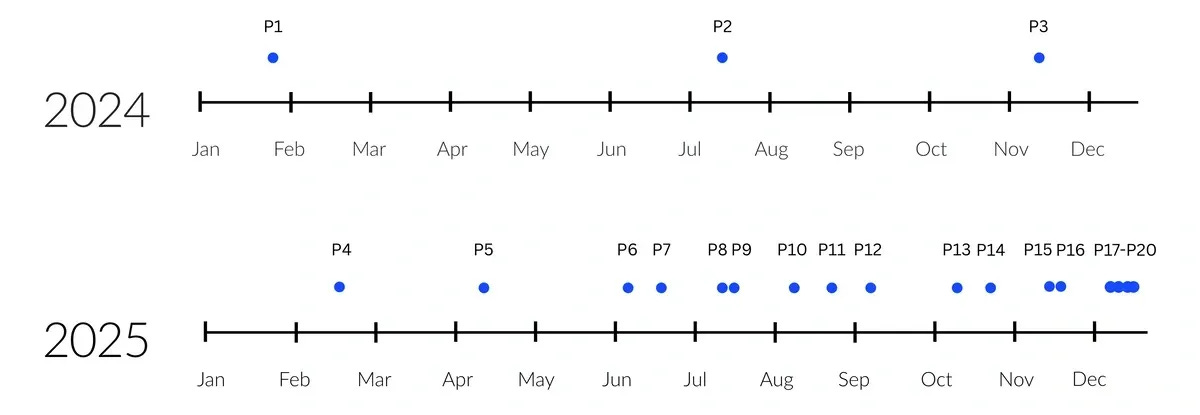
In addition to a rise in the total count of people living with BCI, DBS, or other neural implants worldwide, key technology and business trends will further compound the growth of neural data in the coming decade.
Self-Improving Therapeutics - Motif Therapeutics’ Founder and CEO Jacob Robinson sees therapeutic BCI for mental health evolving on a similar growth arc as solar panels, LEDs, and computers. Charting side-by-side growth of microprocessor transistor count and clinical trials for psychiatric brain stimulation, he describes the latter’s “doubling time of 4.7 years.” But neurotech must become more than just medical devices to reach exponential adoption. AI-native BCI companies will leapfrog the “legacy architectures” designed along narrow regulatory and clinical corridors. The emerging era of improvement-native neurotech should auto-upgrade like the OS on a phone or laptop, driving advances and discovery of new features proactively, in user-informed loops.
Evolution of Interfaces: Five years ago, Dr. Edward Chang wrote about the limits of commercially available BCI tools: “Many of these applications suffer in performance and utility in humans because of the large electrode sizes and low electrode density in FDA-cleared, commercial-off-the-shelf (COTS) electrode arrays.” But that was then, this is now: Chang founded Echo Neurotechnologies two years ago to advance a state of the art BCI system consisting of higher bandwidth arrays, reversible implantation, and fully wireless capabilities, focused on speech restoration and beyond. With new arrays emerging, industry standards for electrode and channel count five years from now feels unimaginable.
New Economics & Economies: Science Corp has paved a business onramp for such startups building novel interfaces to accelerate through clinical studies at a fraction of the hundreds of millions of dollars it normally costs. “Our imperative is to become the first BCI company to scale and achieve profitability,” says chief strategy officer Darius Shahida. “I think that BCI is not a specific product,” noted founder & CEO Max Hodak. “I think there’s going to be a bunch of BCI companies going after different applications where different types of probes will make sense. To me, it firmly feels like we’re in the takeoff era.”
Towards Ultra Futures: Merge Labs is in the early days of combining ultrasound and gene editing to create higher resolution neuroimaging than is currently possible with physical electrode arrays. “One of our core beliefs,” co-founder Mikhail Shapiro told Ashlee Vance, “is that we can build BCI that can interface with many more neurons in the brain than is possible with existing technologies in a form factor that is much less invasive than existing technologies.”
Governance: Gates or Guardrails?
The intended and unintended practices around neural data strategy are of growing global interest from beyond the industry. Last November UNESCO adopted a “non-legally binding” “global legal framework” for ethical development and use of neurotechnology. The World Economic Forum has issued a call for self-governance, calling for “regulation as enabling innovation infrastructure” and advancing a new initiative, the “Neuro Trust Index,” for neurotech developers to align with public interests.
INBRAIN Neuroelectronics CEO Carolina Aguilar’s comments following the company’s AI partnership with Microsoft EMEA show tight self-governance at play: “Neural data generated through an INBRAIN device belongs to the patient, and access is tightly regulated under clinical trial protocols, institutional review board oversight, and all applicable privacy laws. INBRAIN does not commercialize patient data, and Microsoft does not access, store, or own patient-identifiable neural information.”
Protecting patient identity and maintaining regulatory compliance are best practices for any medical device company, but developing advanced “human in the loop” applications into individuals’ preferences and personal digital ecosystems goes beyond healthcare. As for the legion of startups building emerging consumer applications from the growing terabytes of EEG, EMG, speech, image, video, and multimodal data: In the US, a growing patchwork of regulations are now targeting the recording, storage, sharing, and downstream applications of “neural data” with an eye on protecting consumers from data misuse.
Sophisticated governance is challenging. The feasibility of regulating a broadly defined category of data used by consumer and medical device ecosystems remains to be seen. If such laws are passed, regulators must take care to avoid the unintended consequences of hampering access to innovation for people living with stroke, Alzheimer’s disease, severe depression, spinal cord injury, ALS, and other as-yet-uncurable conditions.
Beyond Health: Emerging Applications
Today, decoding neural data drives functional quality of life improvements for BCI end users in clinical studies, driving medtech product development efforts, opening new inroads to drug discovery.
But of course, implanted BCI companies are not the only ones building at the neuro frontier today. As AI redefines the playing field, what will emerge over the next decade? Neural foundation models are creating massive downstream opportunities that span myriad potential use cases across biology, computing, and beyond.
Agents to Agency: Dozens of NeuroAI startups are building next-gen wearable-driven platforms to collect, decode, train on, and harness user intentions into a variety of applications, from wheelchair movement, device control, thought to text, and beyond. Meta’s EMG wristband offers a roadmap, training on 10,000 users so that “out of the box, it can work with a new user it has never seen data for,” as per Patrick Kaifosh, co-founder of CTRL Labs and director of research science at Meta’s Reality Labs.
More Efficient Computing: A recent study showed how an AI built from monkey-derived artificial visual neurons could be re-engineered for far greater efficiency, at comparable performance. The authors offer early speculation about how this could theoretically improve self-driving cars. Bigger questions beyond saving energy are emerging as small computers powered by neural organoids can already play games.
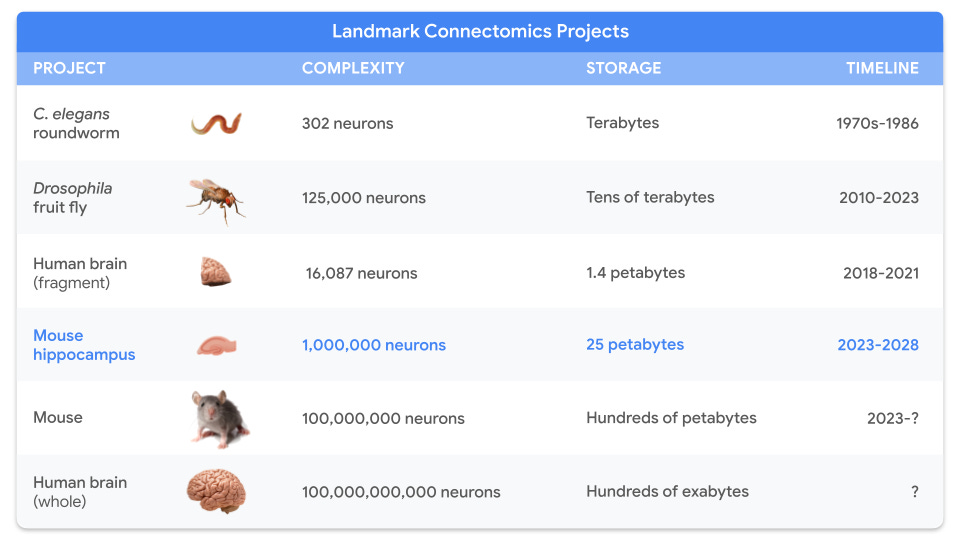
Connectomes Of Mice & Men: Two years after a fly’s brain was fully mapped across neuronal connections (aka a connectome) in the Flywire project, Eon announced the first integrated attempt at a virtual fly simulation that “predicted behavior with 91% accuracy.” The point is not about valuations of a digital drosophila - it’s about wondering what will be possible in two, five, or 10 years that is impossible today. As E11 Bio works to map a mouse connectome, the human brain is drawing more interest, too.
What’s Next?

As addressable markets expand and emerge into view, the possibilities may be virtually infinite.
The interplay of foundation models and today’s leading BCI are already powering cutting edge clinical advances that have never been possible: decoding speech, movement, vision, emotion, touch, and more. It is easy to forget that until this decade, such applications were hard to believe!
From GUI to mouse and keyboard to smartphones to BCI, interfaces between brains and computers have always been a gateway to novel computing paradigms and transformative social applications. The continued emergence of genre-bending uses, novel form factors, more powerful decoders, expansive business partnerships, and intriguing new players is poised to continue.
So where do we go from here? In a word, forward.
In forthcoming issues we will be diving deeper into the key topics driving advances in this frontier, from creative financing strategies to competing for engineering talent to the growing role of globalization in shaping neurotech’s progress. Stay tuned and hit reply:
Startup founders building in this lane - share what you’re working on
Leaders in policy, investing, or ops - I’m eager for your perspectives
Curious readers - let me know what you want to learn more about!
Disclaimer: This content is provided for informational purposes only. It reflects the views of the author(s) at the time of publication and should not be relied upon as financial, legal, medical, or investment advice. Views are subject to change. Featured projects are highlighted for informational purposes only. Inclusion does not constitute an endorsement, recommendation, or investment advice by the author or by PL Neuro. PL Neuro may hold a financial interest in some or all companies referenced. This material may contain forward-looking statements, including projections, plans, and expectations regarding future events or performance. Such statements are not guarantees, involve known and unknown risks and uncertainties, and are subject to change without notice.