

Working in BCI: Culture, Purpose, & Vision
Representations 03: Single KPI + BCI Hiring Map + Rapoport’s Long View + Supercomputing

Representations is a new limited series exploring neurotech’s evolving business frontier. This is produced in partnership with PL Neuro, a project by Protocol Labs. PL Neuro accelerates neurotechnology and neuro AI through field building, strategic investment, and scientific research. Their worldview is deeply technical, yet wholly focused on enabling futures of human flourishing. Over the coming months we’ll explore key topics, trends, and themes, featuring experts from PL Neuro’s ecosystem and market insights from Neurotech Futures’ platform.
Welcome back to Representations. Last month we charted neurotech’s rising tide of leadership, infrastructure, and investability. This built on the business flywheel of data strategies for next-generation implanted neurotechnologies.
Congrats to PLC Neurotech’s newest investment Neurosoft on their oversubscribed $7.5m seed. Adding this to our fundraising tally brings 2026’s year-to-date investments to $658m+ across 25 implanted BCI companies, from 55 investors in over 10 countries, including 20 from China.
Commercialization costs in BCI come down to two categories: people and technology. Today’s leading BCI startups are not just building cutting-edge technology; they are creating conditions that foster successful decision making and attract top talent.
In a word, culture. This edition highlights one of the most popular and important topics in neurotechnology: Working at BCI companies.
On Purpose: Why Motif Neurotech is a One-KPI Company
I caught up with Motif Neurotech’s founder & CEO Jacob Robinson to reflect on the journey to their first-in-human implant for a psychiatric BCI, recently authorized by the FDA and planned for this summer.
You founded Motif Neurotech in 2022, raised a Series A in 2024, won grants from ARIA in the UK and ARPA-H in the U.S., signed new partners and leaders. You’re about to enter the clinical stage. What’s top of mind for you right now?
In Neurotech, we often talk about the devices and the risks, but not the benefits. So as we move towards demonstrating safety in people, I’m thinking about how many people who are struggling now, who just want peace of mind. I hope that we begin to normalize mental health as a biological problem, just like cancer and diabetes, and there’s no more shame in the diagnosis.
Going back to 2022: I had a couple of people, and I had a Slack channel for Motif Neurotech, and our goal was to build something that was going to help affect people’s lives. We developed one KPI, which is days of service. The purpose of the company now is to create days of service for our patients. That number has been zero since 2022. And in a few months, it’s going to go from zero to one, on the day when we implant our first patient.
How does culture drive mission at Motif?
What I realized early on as a founder is that I could not pay people more money than they were making in their corporate job, I could not provide them more security than their corporate job, but I could give them one thing their corporate job might not give them, and that is purpose. When you can build just a small nucleus of people who are motivated by purpose, they attract other amazing people.
The other thing that was really important for us is that I got to know Jen French early on. She really impressed upon me the importance of working with people with lived experience, and so we set up a community advisory board from the beginning. Jon Nelson and Amanda Geisinger shared their journeys at Asilomar last month. Not only does it tell us what the actual users care about most, it keeps us focused on helping people get better.
You just won an ARPA-H grant for Evidence-Based Validation & Innovation for Rapid Therapeutics in Behavioral Health (EVIDENT). What’s that about?
One of the reasons I founded Motif was going to conferences and seeing people try to make sense of brain data from five subjects or 10 subjects, to try to understand something as complex as depression. They’ve done some amazing work with these small data sets, but it made me wonder what would be possible if we didn’t have such an impoverished data set. That’s not how we develop LLMs, right? You don’t train an LLM on, like, five people’s emails, but that’s what we’re trying to do in neurotech in many ways. So EVIDENT is an effort by ARPA-H to address that exact problem: How can we use large data sets to create objective measures and very precise biomarkers of mental health states, so that we are not based on survey scores.
It was 100% aligned with what we wanted to do at Motif from the beginning. What’s really special about the program is that our piece of that is now going to get connected with work from other groups that are measuring things like EEG or proteomics, gut metabolomics, and actigraphy. And so, together we’re going to create this massive multimodal dataset, which will include brain data from the patients who participate in that trial. With that we can finally start to track psychiatric states based not only on what people are communicating with their words, but also with what is actually happening in the brain itself.
You won an ARIA grant in 2024 for Precision Neurotechnologies. This is what seeded your recent partnership with the chip company Mint Neuro, right? Tell us about that program(me) and what makes for a strong commercial partner in neurotech.
The ARIA opportunity was a perfect fit. It’s asking, ‘If the brain is a distributed network, how can we give people an opportunity to regulate that network more effectively?’ That’s the long-term vision of Motif.
And it happened to lead to this partnership with Mint. We knew we needed integrated circuits. We didn’t know where we were going to source them, but Mint was also part of the ARIA grant,so we met them there and they turned out to be fantastic partners for us. I’d say successful strategic partnerships are ones with the right alignment of incentives, so both parties are equally motivated.
It was serendipitous, but my lesson to other folks leaving academia to build startups is that we decided to look for what is already on our roadmap that we can pull forward with grant opportunities. That’s been our North Star.
Follow Motif on LinkedIn for updates on their forthcoming RESONATE trial.
Please consider joining or sharing their patient registry with anyone who might be interested.
On Culture
What even IS culture at an engineering-driven organization? I asked Aditi Chakravarty, an organizational effectiveness leader and the former chief culture officer at Lawrence Berkeley National Laboratory (who is also my wife). In the context of her work driving interdisciplinary leadership development at a 4,000+ person research institution, she said “Culture is the shared values, norms, and practices that shape and dictate behavior in social systems, including workplaces, departments, and teams.”
At startups, the path is rarely linear. After Synchron raised a $200m Series D last year, I asked Tom Oxley about the company’s move to San Diego. He charted the Stentrode’s migration across continents and coastlines, and spoke to the evolution of the CTO’s role from invention through iteration and vertical integration, in driving “hiring, values, culture, organizational development, supply chain, vendor relationships, contract negotiation.”
Speaking on the Juan Benet Podcast, Science Corp’s Max Hodak reflected on how judgment and culture are passed on in organizations: “You can’t really learn this through school. The best way I’ve seen is through apprenticeship. Humans are very mimetic…these cultures are oral traditions and practices. It’s kind of like a Jedi apprenticeship situation where you have to join the group. The only way to learn these things is by making big decisions with jeopardy and stakes attached… You go through a bunch of reps of that, and then you find out if you can learn it or not.”
Matt Angle posted this picture of a banner displaying Paradromics’ company values. An admirable lack of buzzwords!
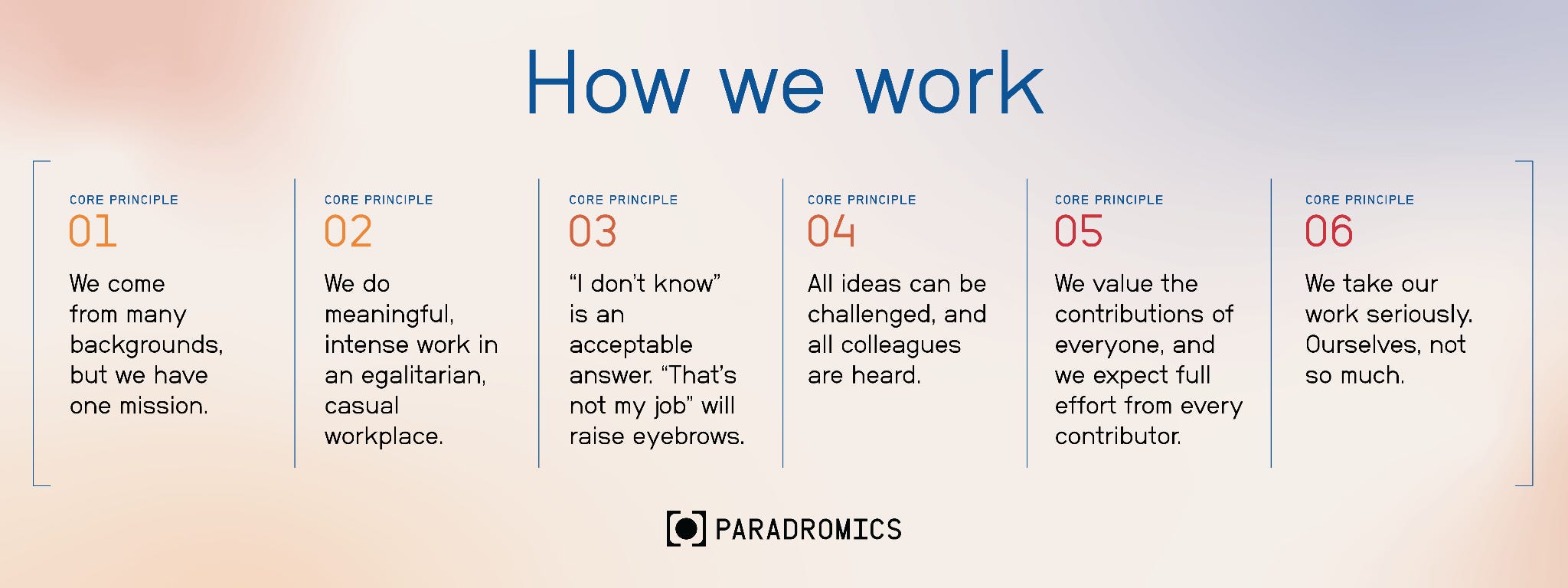
Angle added by email: “We’re building the plane as we fly it. No one knows what a BCI company is supposed to look like. It’s definitely not a normal medical device company, but it’s not a semiconductor company or software company either. We’re building a new industry and culture is a critical part of it.”
What does “culture” mean to you? What does it mean in BCI?
Who is Hiring in BCI?
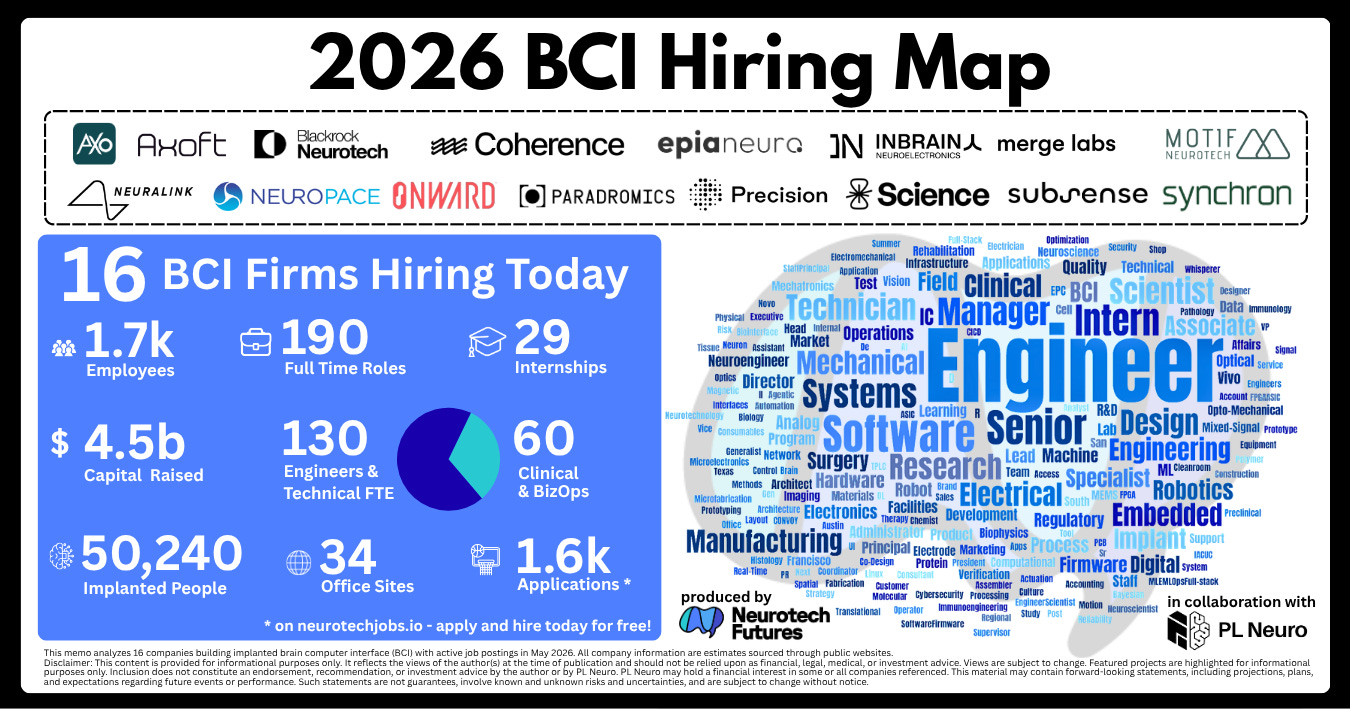
Which implanted brain-computer interface startups are hiring? We scanned through 16 firms with active roles on their career pages to explore the state of hiring today.
Companies at the pre-clinical stage included Axo, Epia, Merge, and Subsense, though many roles at Science are focused on pre-clinical work as well.
Companies with clinical programs, or those soon to enter human stage studies: Axoft, Blackrock, Coherence, Epia, INBRAIN, Motif, Neuralink, Neuropace, ONWARD, Paradromics, Precision,and Synchron. These 16 firms drove one-third of all applications on our job board, despite representing only 11% of the total companies represented since Q4 2025.
68% of full-time roles were technical roles. The other 32% included clinical, administrative, and business roles. Only two of the 16 companies (12%) posted salaries, and 5 firms (32%) had active internships posted. On average, companies were hiring in 2+ office locations, with 29 office locations across the US and 5 located globally.
Browse, apply, and add open roles for free today👉 neurotechjobs.io
Looking for a job in BCI? Watch for an exciting announcement this summer!
Neurosoft Bioelectronics’ Seed Round, New York Office, Hiring Plans, and Supercomputing Partnership
Neurosoft’s oversubscribed seed brings their total funding to $20m and follows an ecosystem partnership with Science Corp to advance their soft electrode platform. Founder and CEO Nicolas Vachicouras weighed in on the startup’s next chapter.
Congrats on the raise. Why is it the right time for Neurosoft to move to NY?
We are introducing a new era of cortex-wide systems neuroscience, leveraging our minimally invasive brain-computer interface platform built on stretchable electronics. The US is our primary market, so the move was natural as we prepare to launch our first product. NYC specifically made a lot of sense: it’s quickly becoming the center of gravity for neurotech in the U.S., and being closer to our collaborators removes friction. We are already in conversations with labs and clinicians who’ve been waiting on hardware like ours, and we’re excited to open that up to more partners across the USA.
What roles are you prioritizing hiring following your raise?
We are growing across research, engineering, and clinical teams. As we scale our clinical trials in Europe and the US, we are collecting an increasing volume of high-quality brain data, and building the neuroAI team to make sense of it. Most of our research hiring targets deep learning and time series specialists for whom neuroscience is a secondary but valued skillset. Our partnership with Science Corporation also creates new roles at the intersection of our electrode technology and their backend electronics.
The Swiss AI initiative recently awarded you a supercomputing grant. What are the business implications for Neurosoft, and supercomputing’s impact on the BCI field more generally?
Recording from the human brain is hard, and high-quality neural datasets are inherently complex: high sampling rates, many channels, across multiple brain regions simultaneously. Processing this type of high-dimensional time series data requires a level of compute that most academic and startup environments simply don’t have access to. The Swiss Alps supercomputer, currently ranked 8th in the world, changes that for us. In practical terms, model training that could take months on conventional infrastructure can be compressed into days or weeks, directly accelerating our path from clinical data collection to generalizable models of brain function.
From a business perspective, this is a meaningful step. At its core, neuroAI is about decoding recorded electrical brain activity into specific brain functions: translating raw neural signals into something clinically meaningful, like movement, speech, or cognition. Faster model iteration means shorter feedback loops between our clinical trials and our AI development, which translates into accelerated timelines for therapeutic applications. Access to compute is becoming a decisive factor in this space, similar to what we saw with large language models. This grant puts us in a strong position to move faster, and to build models that could one day generalize across patients and conditions.
Treating Paralysis and Digitizing Neural Data
The second episode of Juan Benet’s podcast features Dr. Ben Rapoport, chief scientific officer and co-founder of Precision Neuroscience. Rapoport describes himself as a “child of the field”—his father was a neurologist specializing in clinical electrophysiology—and in the interview, he traces the history of brain-computer interfaces, from the 1980s insight that movement is encoded by populations of neurons firing together, to the mid-2010s breakthrough in compute and machine learning that finally made neural decoding practical. He also describes the thinking behind Precision’s once-contrarian bet that electrodes resting on the brain’s surface could decode intended movement just as well as needles penetrating into it.
Rapoport compares today’s effort to map the brain’s electrical activity—across many people, over time, and across different functions—to the way genomics turned a readable biological code into something the tools of computer science could act on.
My biggest takeaway was how Rapoport sees the long arc of his work as a neurosurgeon, electrical engineer, and computer scientist, beginning with his father’s career and extending to his role as a father to two:
People’s concept of what’s acceptable also changes . . . The people who are five years old today, who are going to be the young engineers and physicians and computer scientists coming of age and deciding what to do—when there’s already a platform for development in this space . . . in 5, 10, 15 years their concept of what’s possible, what’s normal, what’s acceptable, and what’s taboo is going to be very different from ours.”
Make sure to subscribe to catch the next episode when it drops!
Visit PL Neuro’s growing hub of content, events, and more: https://plneuro.xyz
Disclaimer: This content is provided for informational purposes only. It reflects the views of the author(s) at the time of publication and should not be relied upon as financial, legal, medical, or investment advice. Views are subject to change. Featured projects are highlighted for informational purposes only. Inclusion does not constitute an endorsement, recommendation, or investment advice by the author or by PL Neuro. PL Neuro may hold a financial interest in some or all companies referenced. This material may contain forward-looking statements, including projections, plans, and expectations regarding future events or performance. Such statements are not guarantees, involve known and unknown risks and uncertainties, and are subject to change without notice.